creations about us shop
October 19th, 2009

Halloween Costumes

ButterflyButterfly wings

How easy were these butterfly wings? Super easy.

Cut an old cardboard box into butterfly shape. Paint. Cut little slits. Thread elastic through. Elastic goes around the arms. Voila.

Bat


The bat was not hard, either. A sweatshirt plus an umbrella. Tutorial here.

October 19th, 2009

Autumn Trees

This craft project was REALLY easy, and gives us actually nice-looking decorations for our dinner table

10/9

Want to make your own? It’s super easy.

Fold 2 pipe cleaners in half and twist to make the trunk. Fold the upper portion out into branches. Cut a third pipe cleaner into smaller pieces and wrap those around the branches to make smaller branches. Grab a wad of play dough (homemade or commercial) and plant the trunk of your tree into it as a base. Cut scrap construction paper into small pieces and glue onto the branches for leaves.  VOILA.

October 18th, 2009

Super Easy Patternless Knit Leg Warmers for Babies

DSC_0028

This can’t get much easier, really.

You’ll need:

Yarn. Any weight. Less than 1 ball, typically.
Needles, double-points, appropriately sized to your yarn.

1. Swatch your yarn with your chosen needles. Make a 2 inch square.

2. Count how many stitches you have in one inch.

3. Measure around your baby or child’s thigh. Subtract 1/2 or 1 inch.

4. Do some math. (stitches per inch) x (inches around thigh - 1/2-1 inch for ease)
Example: My yarn gets 10 stitches per inch, and my baby’s thigh is 9 inches around. After I subtract 1/2 inch, I have 8.5 inches times 10. I get 85.)

5. Cast on the number of stitches you got in step #4. Join in the round. Of course, don’t twist your stitches.

6. Make ribbing for an inch. You can do whatever ribbing you want. k1p1, k2p1, k2p2, k3p1, whatever.

7. After that inch, you have a decision to make. You can make the body of the legwarmers in stockinette (knit every round), or you can make the body of the legwarmers in the ribbing pattern you started with.

8. If you opted to knit the body of the legwarmers in stockinette, keep knitting until your legwarmers are one inch shorter than you want them to be. Then knit another inch of ribbing.

If you opted to knit the body of the legwarmers in ribbing, keep knitting until your legwarmers are the length you want them to be.

9. Cast off. Choose one of the stretchy cast-offs here. I prefer Elizabeth Zimmerman’s sewn cast-off.

10. Make another one.

DSC_0037


Do you crochet? Adapt this pattern to crochet by swatching in whatever crochet stitch you think would work best for your legwarmers. I don’t crochet, and I have no idea what would work, but if you DO crochet, you ought to be able to figure something out, I would think.

June 22nd, 2009

Pillowcase Dresses Tutorial (no images)

Pillowcase dresses are SO SIMPLE!!

5/22 - Genna

Yes, you can start with an actual pillowcase, but you don’t have to! In this case, I just cut some fabric, about twice as wide as she is big around. (So I measured her around the chest, and doubled it.) Sew up one side seam. Now you have a tube, right?

You can either hem the bottom (and you pick which side is the bottom, since when it’s just a tube, either side could be the bottom!) or you can add a length of seam binding, or make a decorative band with another fabric, whatever.

Once you get the bottom hemmed, focus on the top. Lay the dress out, you can put the seam in the back or on one side. Cut out armholes. Like this:

After the armholes are cut, you’ll see only ONE straight part of the fabric that’s not hemmed, right there, top front and top back, between the armholes. Make a casing out of each of those little flaps, just about 1/4-1/2 inch deep.

Now, you need to hem the armholes. You can just hem them, or you could use seam binding. I personally recommend seam binding.

Next, cut two lengths of seam binding long enough to thread through the casing and tie over each shoulder. I recommend sewing the seam binding closed for this purpose.

And you’re all done. Easy peasy.

If you want pictures, post here and I’ll take some and put them up.

August 2nd, 2008

Tutorial: Super Easy Patternless Maternity Skirt

So I made myself two maternity skirts using my Super Easy Patternless A-Line Skirt tutorial as a jumping-off point. There’s no reason you’d have to be pregnant to make skirts like this. Part of the appeal of this style of skirt (for me) is that it is also wearable when not pregnant.

Maternity Skirt

Essentially, I took my hip measurement (which was where I wanted the skirt fabric to start) and used THAT as my waist measurement in the tutorial. Cut out the skirts the same as in the original tutorial.

I then sewed the two halves of the skirt together.

Next, the waistband. Take a knit fabric, and hold it up to your belly so that it stretches around your belly. This is very important if you have a one-way stretch fabric - make sure the stretch goes AROUND you. Stretch it pretty tightly. If you keep it a bit loose, thinking you need the extra room, it will fall off of you. This comes from personal experience - trust me on this. If you’re still early in your pregnancy, you can guesstimate on how much you need around the waist. This is a pretty forgiving project - you can always take it in later if you need to. (You can also use a repurposed Tshirt for the waistband instead of getting knit fabric.)

So, you’ve stretched it around your waist - note how much fabric you used to stretch it around your waist and cut that much fabric, plus a bit for the seam allowance. Make the waistband however wide you want it. I make mine about 12-15 inches wide, then fold them over once or twice so they sit under my belly. I made them wide, though, in case I want to wear them over my belly instead. There’s no need to finish the top edge of the waistband, but you may if you like.

Maternity Skirt (wow, I need a tan.)

Seam up the waistband so it forms a tube. Try it on just to make sure it’s right.

Now, pin it to your skirt, right sides together. I find it most helpful to mark both the waistband and the skirt on either side plus center front and back, then match up the markings when I pin, so I’m sure to have the waistband even.

Sew the waistband to the skirt, hem it, and you’re done.

Note: I did NOT cut the bottom hem at a curve like I normally would for a skirt. I decided to cut the hems straight across. Since I also made these skirts quite wide at the bottom, this gave me a nice angled, pointy hem as you can see in the photos. I chose to hem the black skirt normally, but I decided to hem the green stripe skirt using bias tape around the hem. I like the way it turned out!

Maternity Skirt

May 14th, 2008

Sink Skirt

Sink Skirt

First - could my sink seriously be any grosser? this is the sink the Washing machine empties into, and also is our utility sink for things like washing out paintbrushes. So that’s why it’s so gross. It was fairly gross when we moved in, so not all the grossness is from us!

Anyway. I wanted to make this little area look a little less cluttered. I keep our junk towels under the sink, and was sick of looking at them. This sink skirt was SOOO easy.

I basically just cut a piece of fabric a few inches longer than the length from the sink lip to the floor, and a few inches wider than the sink’s circumference. Hemmed it on all four sides. Sewed the hook part of a strip of Velcro to the top of the curtain. Hot glued the loop part to the sink. (Most places recommend using peel-and-stick Velcro for the sink, but I didn’t have any. But I did have a glue gun that was sad from neglect.) Stuck the curtain on. Voila. Done. It was a 10 minute project, not counting the time spent waiting for the glue gun to heat up, deciding I could knock out a few other quick things while waiting, forgetting I was waiting, and remembering the glue gun about 20 minutes later as it’s oozing hot glue all over the top of my washing machine.

(also, you can see that the area cluttered back up in a hurry. The garbage can has to go there. The floral box is actually a sturdy stepstool for my son to reach the sink. The small bucket is our downstairs hamper for putting towels and wipes that are dirty. That was supposed to go under the sink, but didn’t fit. I’ll have to figure out a way to get it under there.)

November 3rd, 2007

Tutorial: Easy Child’s Cape

Easy Child's Cape

Capes for children (or adults, really) are so easy!

1. Get your fabric. Measure your child from his shoulders to the floor. Get that much fabric.

2. Now, cut it. Lay the fabric out as shown in the diagram and cut where the red line is. Don’t worry about being too precise, you’re just rounding the corner a bit.

3. Hem. Hem the three sides that are curved.

4. Gather the top. Set your machine to the longest stitch length possible and run two rows of stitching across the top (unhemmed) edge. Pull on the threads to gather the top to whatever length you want. Arrange the gathers so they are even across the length.

5. This step is optional, but I find it makes things easier. Using a zigzag stitch, sew over the gathers to lock them in place.

6. Get or make yourself a length of bias tape about 8-12 inches longer than the top of your cape. Leaving lengths of bias tape on either side for ties, sew the tape to the top of the cape, hiding the messy unhemmed edge inside the bias tape.

All done!

February 18th, 2007

Super Easy Patternless A-Line Skirt

Sometimes you just feel like a simple skirt with nice, clean lines. And you don’t have a whole lot of fabric. This easy skirt is perfect! You’ll need two times the length that you want for the skirt. (So if you want a skirt that’s 25 inches long, you’ll need 50 inches of fabric, or about 1.5 yards.)

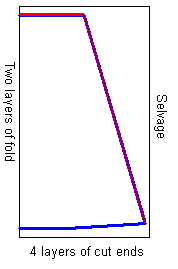
Fold the fabric in half, with the selvages together. Then fold it again so the cut ends are together. You should have four layers of fabric, with a big fold at the top, selvages on the right, two single-layer folds on the left, and four cut ends at the bottom.

.

To use even less fabric, you can use the fabric’s width as your length, then you’ll only need enough to get around your hips plus however much more you want for fullness at the hem. If you’ve decided to go this route, when you first lay your fabric out to fold it, the selvages will be at the top and bottom, with the cut ends on the right and left.

Once you’ve gotten the fabric folded, sketch out your skirt. Or, if you’re like me, live on the wild side, forgo the pen, and start with the scissors! The important part is the waist - measure your waist and add 2 inches, then divide by 4. This is the hot pink line in the drawing. The other two lines are pretty forgiving - the purple line should be as long as you want the skirt plus a few inches for the hem. The blue line just goes from the end of the purple line back to the fold.

You’ll also want to cut yourself a waistband - I like to make it about three inches wide and as long as my waist measurement plus two inches.

Now sew the two panels of your skirt together, right sides facing of course, using 1/2 inch seam allowances. Leave room on one side to add a zipper. Sew in the zipper, then sew on your waistband. Add a button or snap on the waistband. Hem. And you’re finished.

These skirts usually take me about an hour, all told.

Now, I have a very uncurvy frame. There’s about ten inches of difference between my waist at its narrowest and my hips at their fullest. If you have a curvier figure, the straight side seams of this skirt might not be flattering on you. In that case, consider cutting the side seams with a bit of a curve to match your hips like this:

I particularly like this pattern in a vertical stripe, because the way it hangs makes the stripes look like they angle in on the sides.

|